Fly Tying the Anglers Art Season 3 Episode 10

Fly tying (besides historically referred to in England as dressing flies) is the process of producing an artificial wing used by wing line-fishing anglers to catch fish. Wing tying is a manual process done by a single individual using hand tools and a variety of natural and manmade materials that are attached to a hook. Although the recent history of fly tying dates from the middle 1800s, fly tyers were engaged in tying flys since at least 200 AD.
Helen Shaw, an American professional wing tyer, defined fly tying as the "simple procedure of binding various materials to a claw with thread".[ane] Fly tying is a practical fine art grade that many individuals are able to practice with reasonable success and necktie flies which produce results when wing fishing. Information technology is also a hobby that benefits from the fly tyer'southward knowledge of the insects and other food sources that fish consume in the wild.[2]
Fly tying requires some basic equipment; a vise to hold the hook, a bobbin to dispense and provide tension on thread, scissors, pliers and the appropriate materials for the particular fly pattern selected. These materials consists mostly of feathers, fur/creature hairs, threads, and diverse synthetic materials.
Fly tying equipment enables the fly tyer to efficiently and effectively assemble and secure the materials on the claw to produce a particular type of fly. Fly tying materials were originally express to various furs, feathers, threads and hooks. Since the mid-1900s, many more natural and synthetic materials are available to use to necktie flies.[3]
Fly patterns are the instructions or recipes required to create the fly. They specify hook sizes and types, the materials and colors to be used, as well every bit the sequence to exist followed and the assembly methods. There are thousands of possible fly patterns available to the tyer.
Arroyo [edit]
Some view fly tying as an fine art form. East. C. Gregg, in his 1940 publication, stated that "The object of this book will be throughout its entirety to teach in a practical manner the Art of Fly Tying in all its branches."[4]
In contrast, A. One thousand. All-time suggests applied ways to streamline the tying technique.[5] Best emphasizes that wing tying is non only a handicraft but also a science rooted in carefully observing fish and their prey, and so designing and tying artificial flies to replicate that prey in guild to catch fish. One of the first contributions to this approach was made past Preston Jennings in his A Book of Trout Flies. [6]
History [edit]

Ogden'due south improved wing vise (1887)[7]

The wing dresser's tools from The Trout Wing Dresser'south Cabinet of Devices or How To Tie Flies for Trout and Grayling Fishing (1919)[8]
The history of wing tying (and fly blueprint) reflects the evolution and history of wing fishing. Basic fly-tying methods take not changed dramatically from the mid-19th century to the present. Most changes resulted from the introduction and accommodation of new materials, peculiarly synthetics, and new hook designs. Images from the early on literature devoted to wing tying and fly construction do not testify processes significantly different from those used today. The tools associated with fly tying today take, however, evolved along with new technologies. In the mid-19th century flies were tied without benefit of a hook vise. Instead, the claw was held by the fingers as the wing was synthetic. The following is from Rod Fishing in Clear Waters (London 1860):
Your materials being now in a state of readiness, the hook must be first tied on with waxed silk to the finest end of the hair or gut left afterwards cut off the curled end, in this way (Plate vii. No. i): Take the bend of the claw between your left finger and thumb, the shank projecting; identify an terminate of the waxed silk, which should exist almost six inches in length, and the cease of the gut along the underside of the shank; pass the silk over until yous have wrapped it down to the terminate of the shank, and two or three turns back for the head of the fly; accept the plumage or hackle every bit prepared (Plate vii. No. 2), put the indicate of the feather from where it is turned dorsum with the outside next the claw, and hold it there with your left finger and thumb until you pass the silk over it, simply where you left off, wrapping it twice or thrice on its downward rounds to the bend of the claw; take your scissors and cut off the root of the plumage, and the superfluous gut under the curve of the hook, leaving it not quite and then long as the body of the fly has to be made; take the thick end of your feather in your tweezers or pliers and wrap it over three or 4 times close together, following the silk wrappings until it is all, or every bit much as you deem sufficient, twirled on; and so take your silk and pass over the end once or twice; cut off the superfluous part of the plume and wrap upwardly the shank with the silk, evenly and regularly, to form the body of the wing, and fasten off by a loop-knot or two; or, if y'all want a thick-bodied fly or 1 of flossed silk, reject again and fasten off at the shoulder; cutting off the silk left, prepare the feather right with your needle and finger and pollex, and the fly is made or dressed. This is the simplest method.
—Henry Wade, 1860[ix]
Ane of the primeval references to the employ of a fly-tying vise is in Ogden on Fly Tying (London, 1887). Other fly-tying tools—pair of scissors, hackle pliers, tweezers, bodkins, etc.—accept remained remarkably like since the late 1800s.[vii]
Purpose [edit]
Tying artificial flies has always been about imitating some form of fish prey. Significant literature on the concepts of imitation exists especially for trout flies. A Book of Trout Flies – Jennings (1935),[6] Streamside Guide to Naturals & Their Imitations – Art Flick (1947), Matching the Hatch.. Schweibert (1955),[10] Selective Trout - Swisher and Richards (1971),[xi] Nymphs - Schweibert (1973),[12] Caddisflies - LaFontaine (1989),[13] Prey - Richards (1995) are a few 20th-century titles that deal extensively with imitating natural prey. From a human being perspective, many fly patterns practise not exactly imitate fish prey institute in nature, only they are nonetheless successful. A successful or "killing" fly blueprint imitates something that the target species preys on. This has resulted in fly tyers and fishers devising boosted terms to characterize those flies that obviously exercise not imitate anything in particular, yet are notwithstanding successful at communicable fish. These additional terms are inconsistently merely usually associated with trout-fly patterns because of their huge multifariousness, both historical and contemporary. The term Attractor design has been practical to flies which resemble nada in particular but are successful in attracting strikes from fish.[fourteen] Dick Stewart characterizes these same patterns as General Purpose.[15] Dave Hughes describes the same flies as Searching flies and characterizes iii levels of false: Impressionistic, Suggestive and Imitative.[16]
Paul Schullery explains that although much has been written about imitation theories of wing design, all successful fly patterns must imitate something to attract the fish to strike. The huge range of fly patterns documented today for all sorts of target species—trout, salmon, bass and panfish, pike, saltwater, tropical exotics, etc.—are non easily categorized every bit merely imitative, attractors, searching or impressionistic.[17] [18]
Tools and materials [edit]
Tools [edit]
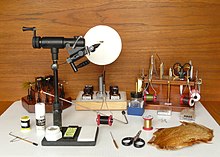

Illustrative selection of modern fly tying tools


Various tools enable and optimize fly tying. Skip Morris, a professional fly tyer, lists the essential tools equally being a vise to hold the hook of the fly to exist tied, bobbin holders, hackle pliers, hackle gauges, piece of work lights and magnifying glass to better encounter the fly as it is tied, hair stackers, scissors and tweezers. Other optional tools are pliers, toothpicks, bodkins,[xix] dubbing twisters, blenders, floss bobbin holders, whip finishers, wing burners and bobbin threaders.[20]
- Vises: Vises are used to hold the hook when tying on materials. They come in diverse forms and may be clamped to a tabular array or come up with their own stand. The vise has a jaw used to hold the hook. On some vises, the jaws will rotate to assist in wrapping material on the hook in a compatible manner. The size of the jaw on some vises may be larger than others to concord a larger hook necessary for some flies, such equally Musky flies. Vises as well might have attached holders for material or for thread when rotating the vise. It is possible to tie a fly without a vise, called in-paw tying; nevertheless, this is very difficult and requires a slap-up bargain of dexterity.
- Bobbin holder: The bobbin holder, commonly referred to equally just "bobbin", is used to hold the thread bobbin when wrapping thread around the hook. The bobbin holder provides tension so that it can be released when the fly tyer is performing other tasks, such equally wrapping hackle.[21]
- Hackle plyers and gauges: Hackle plyers are used to hold the finish of a hackle when wrapping the hackle onto the hook. Hackle gauges are used to select hackle for given size hook and to measure out claw sizes.[21]
- Hair stackers: Hair stackers are concentric tubes of unlike diameter with ane tube having a bottom. This allows the fly tyer to stack hair then that the ends are aligned at 1 end before being applied to the hook. The stacker is usually made of a heavy metal like brass. The bottom of the stacker with hair inserted is pounded on a table a couple of times to help in adjustment the hairs earlier they are pulled out of the stacker while in a horizontal position.[21]
- Scissors and Tweezers: Minor pointed and abrupt tying scissors are used to cut fly tying textile. A second set of pair of scissors or plyers are used for cutting wire and heavy materials that would easily dull the tying scissors. Tweezers are used pick up or hold materials similar beads that applied to the hook.
- Whip finishers: A whip finisher is a tool for tying the thread around the hook that secures the thread in place.[21]
- Dubbing and dubbing twister: Dubbing is made of hair or synthetic fabric that is ground up and practical to the outside of thread. The dubbing can be fine for small dry flys or coarse. Sometimes, dubbing wax is used in moderation to help in applying the dubbing fibers to the thread. The dubbing adds color and bulk to the wing and sometimes gives it a buggy look with coarse dubbing. A dubbing twister is used to apply dubbing to two strands of thread. Information technology has a handle and two wires to concord the thread loop autonomously. The dubbing is applied betwixt the two strands of thread and the twister is spun to twist the thread and dubbing together.[21]
Materials [edit]

Foam Protrude with buggy dubbing

Blackness and Brown Wooly Worm with bead head
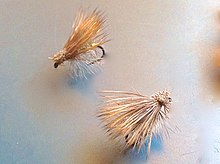
Wing tying fabric tin be anything used to construct a fly on a hook. Traditional materials were threads, yarns, furs, feathers, hair, tinsels, cork, balsa and wire. Today's materials include not only all sorts of natural and dyed furs, pilus and feathers, but also a broad assortment of synthetic materials. Rabbit, mink, muskrat, play tricks, acquit, squirrel, deer, elk, and moose hair and other furs are normally incorporated into bogus flies. Synthetics have allowed fly tyers to replicate rare and sometimes endangered furs and feathers also as create completely new types of flies. Synthetics such as condom legs, foam bodies, plastic wings, transparent plastic cords, chenilles, and all sorts and colors of flashy materials that can be incorporated into the wings and bodies of today'southward artificial fly are bachelor to the wing tyer. Whereas lead wire (11.34 gm/cm3) was the traditional method of weighting flies, today'south weighting materials include beads, cone heads, and atomic number 82-free wire (made from a nontoxic heavy alloy). Silicone, epoxy, kevlar materials are regularly incorporated into modernistic artificial fly patterns.[22] [23] [24] [25]
- Hooks: The hook determines the basic size and shape of each fly and is generally an important part of whatsoever fly blueprint clarification. Hooks come in a wide range of size, shape, length and weight, and must be selected to complement the pattern being tied and the method by which it will be fished. Claw sizes are measured with a number that gives the size of the hook gape. The smallest fly hook starts are in the range #32 to #24 (rarely used by most fly tyers and anglers), followed past #22, #20, #xviii, #16, #14, #12, #10, #8, #6, #5, #4, #three, #two, #1, #1/0, #2/0, #3/0, #four/0, #5/0, #6/0, #7/0, #8/0 and #nine/0. (Missing odd numbers are not used for smaller hooks.) The hook size relates to the size of the gape of the hook. The length of the claw is designated as 1X, 2X, 3X, etc., which is the length of the hook in terms of multiples of the gape. Hooks are fabricated of wire. The wire is lighter for dry fly hooks to aid the fly bladder amend. Flies constructed for use in salt water are typically tied on corrosion-resistant hooks. The diverse manufactures use different numbering schemes to farther define the shape of the hook, eye of the hook, and wing blazon (dry, nymph, stream, scud, Klinkhammer, etc.).[21] [26]
- Thread: Fly tying thread comes in a multifariousness of colors and sizes. Almost modern fly tying thread is made of nylon or polyester. Special use thread may be fabricated of gel-spun polyethylene (GSP), Kevlar, silk, or even Monofilament fishing line. The size of the thread is measured in either denier or aughts. A denier weight specification states how many grams 9,000 meters of the thread weighs. Unlike the mutual thread weight system, the greater the denier number, the thicker the thread. The Wapsi Fly Company uses denier to specify the size of its UTC Ultra thread, which comes in 70, 140, 210, and 280 denier. Some thread manufacturers producing very fine silk threads used in fly tying (Danville Chenille Company and UNI Products), apply their own scales of thread measurement using "aughts" or zeroes. Within a given manufacturer's spectrum, a higher "aught count" indicates a finer thread: this is usually given as a single digit followed by a forward slash and a zero, east.1000. six/0, 8/0, and ten/0.[21] [27]
- Feathers/hackle/herl: The long feathers of the neck of poultry are referred to as hackle. Rooster/hen cervix and saddle hackle, then essential for many artificial fly patterns, are from animals especially bred to produce hackles of superior performance, size and color. Hackle and feathers are sold individually or as a saddle, cape, wing, or tail department. Feathers from other birds are also used in fly tying, including coot, CDC, Duck, goose, grouse, guineafowl, jackdaw, bluejay, magpie, mallard, moorhen, partridge, pheasant, quail, snipe, starling, Eurasian teal, turkey, and woodcock. Peacock and ostrich feathers, called herl, are also used in fly matter. The soft, oily feathers from the back of a duck, called Cul de canard (CDC), are very buoyant and oftentimes used in dry out flies.[21] [28]
- Chaplet: Beads are used as a caput for weight in moisture fly patterns. They take a hole drilled through the center of the bead and are applied onto the hook and pushed up to behind the eye. Slotted holes are also bachelor for jig head hooks. Chaplet are sized to the claw and come in diameters of 1/16 (#eighteen-#22), v/64 (#16-#xx), three/32 (#fourteen-#xviii), 7/64 (#12-#16), 1/8 (#x-#14), 5/32 (#8-#12), and 3/sixteen (#six-#x) inches. Weighted chaplet are made from either tungsten (19.3 gm/cm3), nickel (8.ix gm/cm3), or contumely (viii.four to 8.73 yard/cm3). Although the most common colors in patterns are gold, silverish and brass, a wide variety of colors and textures are available.[21]
- Biots: A biot is sturdy, tapered fiber from a goose or turkey fly feather. Commonly, it is used in fly patterns to imitate tails, wings, bodies, legs or antennae. Natural biots are white or brown simply they besides died a diversity of colors.[21]
Patterns [edit]

Early on colour plate showing fly tying steps (1860)[29]

The Parachute Adams Dry Fly has a down eye and a parachute wing with hackle wound around the parachute[21]
The fly blueprint is the recipe for any particularly named wing. In older literature, specially prior to the 20th century, fly patterns were referred to equally dressings. The blueprint specifies the size range and type of hook to be used, materials including type, color and size, and in some cases specific instructions on the order of application of materials and how to achieve a particular result or configuration. Fly patterns allow tyers to consistently reproduce any given fly over fourth dimension. A Light Cahill dry fly produced by i tyer will await remarkably like to the same fly produced past a completely different tyer if the pattern is followed with reasonable accuracy and with comparable materials. Patterns may also lay out alternatives for different materials and variations.
Traditionally, fly patterns have been found in fly-angling and wing-tying literature and periodicals. Although fly patterns practice provide some consistency, different writers may publish patterns with small to moderate differences across pattern descriptions for the same fly. In many cases, greatest differences are in the tying technique rather than in the form, colour or materials. Fly patterns may or may not accept an image or cartoon of the finished wing to guide the tyer. Historically, fly patterns have been included in texts that discuss angling with a particular genre of wing, fly-fishing technique or wing-fishing for specific species or genre of gamefish. There are, however, texts that are pure wing pattern and tying references with little or no pedagogy on how to fish them.
The Internet has made available new avenues for fly tying instruction, especially with footstep by step illustrated instructions with tying recipes published on websites and YouTube videos. In-person fly tying instruction and ascertainment is another valuable source for learning wing tying.

Typical parts of a Salmon Fly. The hook eye tin be direct, sloped downwards, or sloped down and turned 90 degrees for a jig eye.[30] * A – Tag * C – Tail * D – Butt * Eastward – Hackle E2 – Throat Hackle * F – Nether Wing * G – Over Fly * HH – Horn * J – Side * Thousand – Cheek * L – Head
Salmon flies accept historically been the one of the most complex and elaborate artificial flies to tie. Texts describing fly tying techniques ofttimes utilize an paradigm of a salmon fly to describe all the parts of an artificial fly.
The typical fly pattern appears something like ane of the illustrative patterns below for the Adams dry fly (without tying instructions) or the Clouser Deep Minnow (with tying instructions). Based on the wing blueprint, a knowledgeable fly tyer tin reproduce the fly with the materials specified.
| Typical Fly Pattern Descriptions | |
|---|---|
| Wing | Pattern |
| #10 Adams dry fly |
|
| Clouser Deep Minnow Streamer |
|


Historically, fly blueprint types accept evolved along with fly fishing itself and today there are by and large recognized pattern types. However, none are absolute, as there is much crossover in patterns and blueprint types. Typically the wing tyer will encounter patterns classified as dry out, wet, soft hackle (wet fly with hackle neckband), emerger, nymph, scud (freshwater crustaceans), terrestrial (hoppers), streamer, salmon (Atlantic), Steelhead trout and Pacific salmon, bass, popper, panfish, Carp, saltwater, Northern pike, Bonefish, or musky fly patterns. Even inside these categories, there tin exist many sub-categories of imitative and non-imitative wing patterns.
Commercial marketplace [edit]

A production fly tyer'south demote and materials
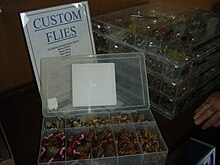
Hand-tied flies on the commercial market sell for under a US dollar to several U.s.a. dollars each. Fly tying is a challenging and rewarding hobby for some, a coin-saving strategy for others, and a assisting commercial enterprise for the professional tyer. The professional or commercial wing tyer may produce upwards of 36 thousand flies annually, whereas the amateur fly tyer may necktie only a few flies each season for personal utilize.[33]
Notable fly tyers [edit]
- Dan Bailey (American, 1904–1982, creator of Greenish Drake and other flies)[34]
- Rosina Megan Boyd (English language, 1915–2001, Salmon Flies)[35]
- James Deren (American, –1983, created The Fifty Degrees and Deren's Fob Dry Wing)[36]
- Jack Gartside (American, 1942–2009, fly tying author, line-fishing known for his impressionistic style of tying)
- George F. Grant (American, 1906–2008), fly tying writer and first to promote the importance of nymph patterns)[37]
- Frederic Grand. Halford (English, 1844–1914)[38]
- Bernard "Lefty" Kreh (American, 1925–2018, creator of Lefty's Deceiver)[39]
- Don Martinez (American, 1903–1955, developed Woolly Worm (simulated)[40]
- Louis Rhead (English, 1857–1926)[41]
- Frank Sawyer (1906–1980, created Pheasant Tail Nymph)[42]
- Carrie G. Stevens, (American, 1882–1970, created Grey Ghost Streamer)[43]
- Lee Wulff (American, 1905–1991, noted for his Wulff series of dry flies)[44]
Meet also [edit]
- American Museum of Fly Line-fishing
- Artificial fly
- Catskill Fly Fishing Middle and Museum
- Feather
- Fish claw
- Fly line-fishing
- Wing Tyer (magazine)
- Japanese Flies
- List of poultry feathers
- Manufacturers of fly tying materials and tools
- Bibliography of wing fishing (wing tying, stories, fiction)
References [edit]
- ^ Shaw, Helen (1963). Fly-tying—Materials, Tools and Techniques. New York: The Ronald Printing Company. iii.
- ^ Leonard, J. Edson (1950). Flies-Their origin, natural history, tying, hooks, patterns and selections of dry and moisture flies, nymphs, streamers, salmon flies for fresh and salt water in Northward America and the British Isles, including a Dictionary of 2200 Patterns. New York: A.Southward. Barnes and Visitor. p. 33.
- ^ Wakeford, Jacqueline (1992). Fly Tying Tools and Materials. New York: Lyons & Burford Publishers. p. reface. ISBNane-55821-183-7.
- ^ Gregg, E. C. (1940). How To Tie Flies. New York: A. S. Barnes and Company. vii.
- ^ Best, A. Thou. (1989). Production Fly Tying. Boulder, Colorado: Pruett Publishing Visitor. ISBN0-87108-781-2.
- ^ a b Jennings, Preston J. (1935). A Book of Trout Flies. New York: Crown Publishers, Derrydale Press.
- ^ a b Ogden, James (1887). Ogden on Fly Tying, Etc. London: Sampson Depression, Marston, Searle & Rivington. p. six.
- ^ McClelland, H. G. (1919). The Trout Wing Dresser's Chiffonier of Devices or How To Tie Flies for Trout and Grayling Line-fishing. London: The Fishing Gazette. p. 63.
- ^ Wade, Henry (1860). Rod-Fishing in Clear Waters By Fly, Minnow and Work With a Brusk and Like shooting fish in a barrel method to the Fine art of Dressing Flies. London: Bell and Daldy. p. 132.
- ^ Schwiebert, Ernest G. Jr. (1955). Matching The Hatch-A Practical Guide to Imitation of Insects Found On Eastern and Western Trout Waters. Toronto, Canada: The MacMillan Visitor.
- ^ Richards, Carl; Swisher, Doug (1971). Selective Trout-A Dramatically New and Scientific Arroyo to Trout Line-fishing on Eastern and Western Rivers . New York: Crown Publishers. ISBN9780517521335.
- ^ Schwiebert, Ernest (1973). Nymphs-A Consummate Guide to Naturals and Imitations. New York: Winchester Printing. ISBN0-87691-074-6.
- ^ LaFontaine, Gary (April 28, 1989). Caddisflies. Lyons Press. ISBN0941130983.
{{cite volume}}: CS1 maint: date and year (link) - ^ Brooks, Joe (1972). Trout Angling. Harper Row. ISBN0601053230.
- ^ Stewart, Dick; Allen, Farrow (1993). Flies for Trout. New York: Lyons & Burford. ISBN0-936644-14-1.
- ^ Hughes, Dave (1999). Trout Flies-The Tier'southward Reference. Mechanicsburg, PA: Stackpole Books. ISBN978-0-8117-1601-7.
- ^ Schullery, Paul (1996). American Wing Fishing-A History. Norwalk, CT: The Easton Press. pp. 85–99, 228–234.
- ^ Schullery, Paul (July 7, 2006). Rise, The: Streamside Observations on Trout, Flies, and Fly Fishing. ISBN0811701824.
{{cite book}}: CS1 maint: date and yr (link) - ^ A wing tying bodkin is a version of a sewing needle, which is usually mounted in a handle.
- ^ Morris, Skip (1992). Wing Tying Made Clear and Unproblematic. Portland, OR: Frank Amato Publications. ISBN1-878175-13-0.
- ^ a b c d e f g h i j chiliad Craven, Charlie (July 15, 2008). Charlie Craven'south Bones Fly Tying: Mod Techniques for Flies That Grab Fish. Headwater Books. ISBN978-0979346026.
{{cite volume}}: CS1 maint: date and year (link) - ^ Wakeford, Jacqueline (1992). Fly Tying Tools and Materials. New York: Lyons & Burford Publishers. ISBN1-55821-183-7.
- ^ Morris, Skip (1992). Fly Tying Made Clear and Simple. Portland, OR: Frank Amato Publications. ISBN1-878175-thirteen-0.
- ^ Clarke, Barry Ord (1996). The International Guide to Fly-Tying Materials. McGraw Hill. ISBN0070119430.
- ^ Leiser, Eric (1973). Fly-Tying Materials: Their Procurement, Utilize, and Protection. Crown Pub. ISBN0517503506.
- ^ "Fly Hook Sizes". Riverbum. Archived from the original on October 26, 2020. Retrieved Feb 23, 2021.
- ^ Cravin, Charlie (27 June 2017). "Agreement thread sizing and construction materials". Fly Fisherman. Archived from the original on February 28, 2021. Retrieved February 26, 2021.
- ^ "Wing tying feathers". Wing Tying Visitor . Retrieved March viii, 2021.
- ^ Wade, Henry (1860). Rod-Fishing in Clear Waters By Fly, Minnow and Piece of work With a Brusk and Easy method to the Art of Dressing Flies. London: Bell and Daldy.
- ^ Kelson, George M. (1895). The Salmon Fly-HOW TO Dress IT AND HOW TO USE IT. London: Wyman and Sons Ltd. pp. 17–eighteen.
- ^ Stewart, Dick; Allen, Farrow (1993). Flies for Trout. New York: Lyons & Burford. p. 2. ISBN0-936644-14-1.
- ^ Clouser, Bob (2006). "The Original Clouser Deep Minnow". Clouser's Flies. Mechanicsburg, Pa.: Stackpole Books. pp. 31–39. ISBN0-8117-0148-4.
- ^ All-time, A. Thou. (1989). Production Wing Tying. Boulder, Colorado: Pruett Publishing Company. Forward. ISBN0-87108-781-2.
- ^ Staples, Bruce (2002). Trout State Flies from Greater Yellowstone Masters. Portland, OR: Frank Amato Publications. p. 62. ISBN1-57188-248-0.
- ^ "Megan Boyd, salmon fly-tier". Edinburgh: The Scotsman. December iv, 2001. Archived from the original on 2014-12-23. Retrieved 2014-12-01 .
- ^ Levin, Dan (Nov 24, 1969). "Lures, Lines And Philosophy Are The Stock-in-trade At Jim Deren's Angler's Roost". Sports Illustrated . Retrieved September 9, 2013.
- ^ "Federation of Flyfishers Awards-Past Recipients". Archived from the original on 2010-06-20. Retrieved 2010-03-30 .
- ^ Halford, F. 1000. (1886). Floating Flies and How to Dress Them. A Treatise on the Nearly Modernistic Methods of Dressing Bogus Flies for Trout and Grayling with Total Illustrated Directions and Containing Ninety Hand-Coloured Engravings of the Most Killing Patterns Together with a Few Hints to Dry-Fly Fishermen. London: Sampson, Depression, Marston, Searle, and Rivington.
- ^ * Randy Berry (American, September 13 1945–June eleven, 2011, Inventor of the Teton Valley Chernobyl Ant) "Fly Fishing Hall of Fame". Fly Fishing Center and Museum, New York. Archived from the original on October 8, 2019. Retrieved Feb 23, 2021.
- ^ "The Past and Present of Wing-Fishing in Jackson Hole, Wyoming: An Interview with Jack Dennis". Register of Wyoming. 76 (two). 2004.
- ^ Rhead, Louis (1919). American Trout Stream Insects-A Guide to Angling Flies and other Aquatic Insects Attracting to Trout. New York: Frederick A. Stokes and Co.
- ^ Sawyer, Frank (2006). Nymphs and the Trout. Salisbury: Sawyer Nymphs Ltd.
- ^ Hilyard, Graydon R. and Leslie K. (2000). Carrie Thousand. Stevens-Maker of Rangeley Favorite Trout and Salmon Flies. Mechanicsburg, PA: Stackpole Books. p. 134. ISBN0811703533.
{{cite book}}: CS1 maint: uses authors parameter (link) - ^ Bates, Joseph D. Jr. (1970). Atlantic Salmon Flies and Fishing. Harrisburg, Pa.: Stackpole Books. p. 266. ISBN0-8117-0180-viii.
External links [edit]
-
 Media related to Wing tying at Wikimedia Commons
Source: https://en.wikipedia.org/wiki/Fly-tying
0 Response to "Fly Tying the Anglers Art Season 3 Episode 10"
Post a Comment